Happiness vs. Feelings, Or 4 Times I’ve Cried in the Last 52 Hours
Posted by Ms. Herr in human dimensionality, life, self-portraiture on June 21, 2015

Image Source: Moyan Brenn on Flickr
Recently, a friend asked me if I was a generally happy person. “Because you seem to be,” he added when I didn’t immediately answer. A rare question, at least when asked directly, but certainly not an unusual one. I suspect most of us have faced variations of this question over the years.
Happiness has not been my favorite topic. It can be taboo particularly when someone has not achieved or chosen happiness. Admitting to unhappiness seems tantamount to admitting failure. And I can’t help but feel that discussions of how happy one is will lead to some sort of twisted pissing contest in which one or more parties begin internally comparing themselves to others (or what they are reading).
I did not ask my friend how he came to formulate this “generally happy person” impression, so I’ll suppose two things. First, his observations are largely influenced by what I post on Facebook, Twitter, and Instagram. We don’t see each other often, so these are our primary means for eavesdropping on each other’s lives. Second, when we do see each other, I’m probably super upbeat and positive. (Duh, silly, I’m practically, but not literally, pooping rainbows because I get to hang out with you.)
So back to social media. People constantly curate (and by curate, I also mean censor) themselves online, sharing more of the good and less of the bad. More of what they want others to know about them, less of what makes them vulnerable. Insert the whole side topic of links between social media and self-esteem and depression here.
Unnecessary News Flash: I curate (censor) myself on social media too.
Yup, that’s right, there are things that I don’t share on social. Like that I’ve cried 4 times in the last 52 hours. And here’s why:
- Friday mid-morning – LONELINESS. More specifically, I was feeling the void of non-companionship, and in that void, I’m always haunted by doubt that I will ever find the companionship I crave.
- Friday afternoon – DEVASTATED BY RACISM. In the wake of the Charleston Church Massacre, as with many recent events fueled by racial tensions, my Facebook feed has filled with articles about white privilege and institutionalized racism. There was a time when I would have claimed to not be racist, but I can not learn about such things and cling to that claim. I benefit from circumstances I was born into. I’m torn to bits when thinking about circumstances friends were born into. I feel horribly ill-equipped to alter the course of systemic racism, and this leads to a whole rabbit hole of thoughts and emotions.
- Friday night – LOVE & GRATITUDE FOR MY PARENTS. I get weepy over this one a lot. I f*cking hit the jackpot with my parents (which is weird, cause I’m pretty sure fetal gambling is illegal in all 50 states). Their love and support blows me away. They’re among my best friends. I would hang out with them on the regular if we were neighbors. («– That’s called foreshadowing.)
- Saturday afternoon – AWED BY A FRIEND’S BEAUTY. As I began to comment on how stunning a friend looked in her new Facebook profile pic, I felt familiar nagging discomfort with compliments on appearance and directed my thinking toward non-physical qualities that made this woman beautiful. I also started mentally clicking through the many people I know who are beautiful inside and out, until my awe had little awe-babies and it got a little overwhelming.
Four cries. (It’s been an emotional couple of days.) Two fueled by pain and sadness, and two by joy and gratitude. Two and two. Unhappy and happy (although I think gratitude can have a dark side which I won’t get into here). Checkmate on the teeter-totter.
Four is hardly a decent sample size. It’s certainly not enough to confirm or deny my general happiness. Which I’m not trying to do. So why have I written 650+ words and still not gotten to the point?
 I was, as my dad would say, a happy sick kid. I wasn’t sickly, but when I was sick, it didn’t get me down. I’d laugh and smile even while retching into a coffee can late into the night while Elvira hosted campy horror flicks like Attack of the Killer Tomatoes. There are few periods in my life I can readily recall as being dark. The darkest of them occurred four years ago. It followed the demise of a relationship, after which, to be blunt, I no longer felt I was interesting as a person. (Brake check. Don’t get caught up on the utter destruction of my self-confidence. It’s still not the point.) You know the quote, “‘Tis better to have loved and lost than never to have loved at all.” Sorry, Lord Tennyson. I don’t agree. But “to know true joy you must also know true pain”* rings like a monster gong. The brokenness I felt during my darkest days unlocked magnitudes of emotion I had not previously accessed. It also changed my relationship with happiness.
I want to be happy, and yes, I am a generally happy person, but I’m not fixated on finding, achieving, or choosing happiness. Life is full of ups and downs. The ability to feel all these feels on the great spectrum of emotion with such overwhelming potency – that is a beautiful and magical thing!
*I don’t remember the specific quote, but if you know it, please share in the comments.
Congratulations
Your first AWS Elastic Beanstalk Node.js application is now running on your own dedicated environment in the AWS Cloud
This environment is launched with Elastic Beanstalk Node.js Platform
What’s Next?
- AWS Elastic Beanstalk overview
- AWS Elastic Beanstalk concepts
- Deploy an Express Application to AWS Elastic Beanstalk
- Deploy an Express Application with Amazon ElastiCache to AWS Elastic Beanstalk
- Deploy a Geddy Application with Amazon ElastiCache to AWS Elastic Beanstalk
- Customizing and Configuring a Node.js Container
- Working with Logs
Day in the Life Nº 01 – Reflections
Posted by Ms. Herr in human dimensionality, life, self-portraiture on February 18, 2014
Tuesday, January 28, 2014
My first #dayinthelife was largely about setting the baseline. I wanted to share a regular day, following the activities and behaviors that I most frequently repeat. Over the next 11 months, and 11 project days (the next of which is Friday), there will be plenty of time to explore detours and variations in the pattern.
Click for video slideshow of
Day in the Life Nº 01
A friend that had followed my first day of documentation via Instagram asked me how I would know if the project had been successful.
While conceiving this Day in the Life project, I never saw it as one that would succeed or fail. I had, and still have, a goal, but this may be best described as an exercise in observation and storytelling. Looking at my days through this lens forces me to be more aware of how I move through a day. I cannot rely on habit to propel me forward. I have to acknowledge my activities, routines, and behaviors as well as the motives that drive or inhibit them so that I may better understand how they contribute to my enjoyment of life and self.
The activities that comprised my baseline day are not particularly extraordinary or unique. I enjoyed doing them. I enjoyed documenting them. Aware of them, I appreciated them individually and together. I went to bed kind of loving the day I had, and in that alone, #dayinthelife was successful.
That said…
I am disappointed that work – the thing that I dedicate more time to than anything else I do (even sleeping) – is also hardest for me to share. It’s not a matter of confidentiality; I know what I can and cannot disclose. It’s a matter of time. This first #dayinthelife proved that documenting my activities is a time-consuming process. When I barely find time for lunch, it’s hard to imagine finding time to take and post pics of the things that make it hard to find time for lunch.
Congratulations
Your first AWS Elastic Beanstalk Node.js application is now running on your own dedicated environment in the AWS Cloud
This environment is launched with Elastic Beanstalk Node.js Platform
What’s Next?
- AWS Elastic Beanstalk overview
- AWS Elastic Beanstalk concepts
- Deploy an Express Application to AWS Elastic Beanstalk
- Deploy an Express Application with Amazon ElastiCache to AWS Elastic Beanstalk
- Deploy a Geddy Application with Amazon ElastiCache to AWS Elastic Beanstalk
- Customizing and Configuring a Node.js Container
- Working with Logs
Day in the Life Nº 01 – Timeline
Posted by Ms. Herr in human dimensionality, life, self-portraiture on February 13, 2014
My first #dayinthelife was over two weeks ago. My next is next week.
When setting out on this project, I had intended to follow each designated #dayinthelife with two look backs. The first was to be a recap of the day, aggregating the day’s posts, wherever they may have been shared, into a single timeline here. The second was to be a reflection on the stories, struggles, and insights that may have emerged for me.
I had also intended that these two look backs be posted on the two days immediately following each #dayinthelife. I still intend to do the recaps, I’m just really late with first. So, without further ado…
Tuesday, January 28, 2014
4:38am » gaming, Marvel World of Heroes

I should be sleeping, but it’s the second or third time I’ve woken up. I rarely sleep through the night. Instead of trying to go back to sleep for the remaining hour till my first alarm, I yield to habit and open up a game on my phone. Marvel World of Heroes. It’s the last day of a raid and I have a ton of RDS yet to use. Plus there’s one card I’m still trying to get via shard exchange.
4:59am » #dayinthelife documentation
5:41am » resisting rise and shine
I’ve already hit snooze a couple of times while playing WoH, but I still procrastinate getting out of bed. I scan new email; browse Instagram, Facebook, and Twitter; and hold an internal debate as to whether I really want to get up now and go for a run, or save it for later today or another day. This morning though, I’m aware that I am documenting my day and am eager to make a good impression.
5:52am » alarm #1, snooze #3
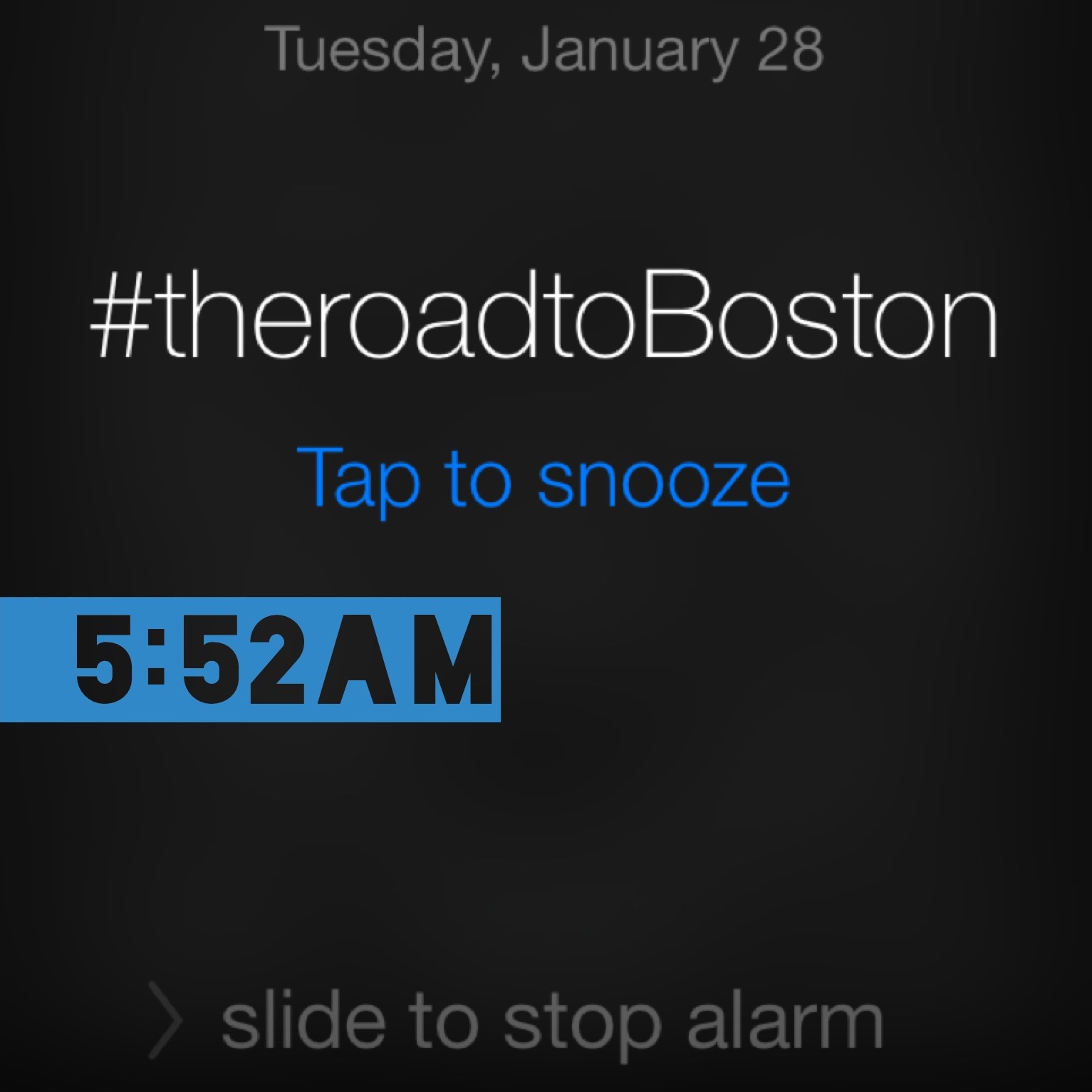
I title all of my alarms. #theroadtoBoston references a long-standing goal to qualify for and run the Boston Marathon.
I also set unique ringtones for most alarms. This one is ‘Kung Fu Fighting‘ by Cee-Lo & Jack Black from the Kung Fu Panda soundtrack.
6:10am » pre-run prep
This includes getting dressed and wandering around my house trying to remember where I was when I took off my trainers after my last run. It doesn’t include stretching. It’s a bad habit and one I know that I should probably try to break.
6:27am » running
How far do you run? It’s the most common question once people learn that I’m a runner. The loop that forms the base for almost all of my runs is roughly 3 miles at its shortest. I can easily extend it in a few places to accommodate and 10+ mile run. This morning, however, 3 will be enough.

Getting up to run on winter mornings is hard. I hate being cold and even in these mild Phoenix winters, my core body temp drops so much after a run that I inevitably get chills that last for an hour or more. But the payoff for getting out of bed with an early alarm is knowing that I’ve checked a big thing off the to do list before most people have started their day, and seeing the sun start its rise.
7:03am » post-run documentation
After every run, even if it’s a familiar loop, I map it with gmap-pedometer.com, record it at Daily Mile and Daytum, and share it on Facebook and Twitter. When training for an upcoming marathon, I also record runs in a spreadsheet where I’ve laid out my entire training program and, if necessary, make adjustments to upcoming workouts.
7:25am » so fresh so clean sequence, morning edition
Most days, I need less than an hour, but with the time this #dayinthelife documentation has been taking so far, I know that today I will take significantly more.
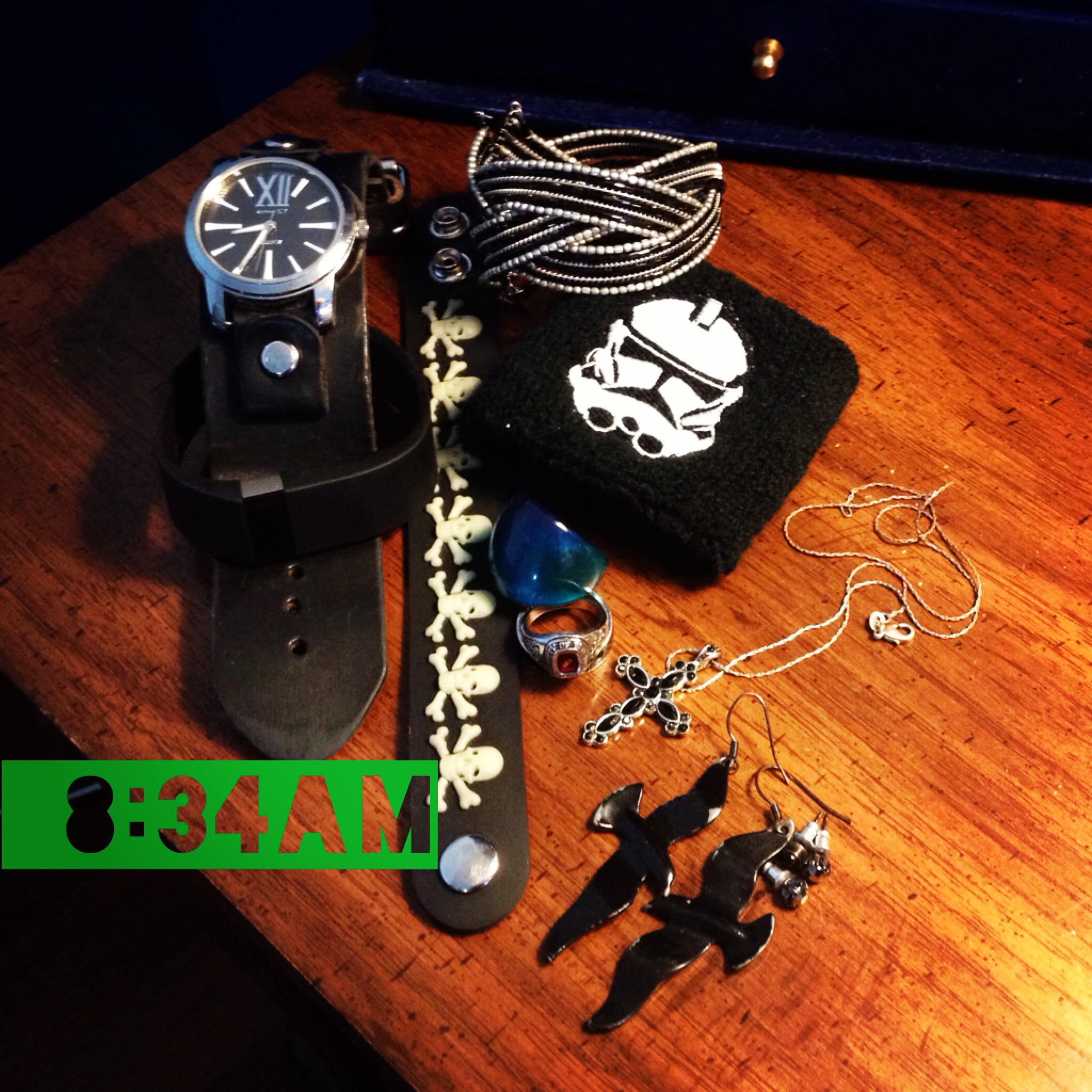
The last thing I do before heading out into the day is don a motley collection of accessories. Some pieces I wear everyday. Others I switch up. Most have significance, even if only that I’ve become attached to them as part of how I present myself. Today is dominated by black. The wideband black Nemesis watch, my #Fitbit Force, and a Jolly Roger wristband that my sister gave me and is just plain fun go on my left arm. The clone trooper wristband (because my Beatles band is MIA) and a simple beaded bracelet go on my right. The big turquoise ring that has become my favorite, a black band for my thumb, and my UNM class ring. A cross necklace, because while I am not as close to my faith as I once was, it remains important to me. Birds in flight to dangle from my ears and the same stud earrings I wear everyday.
8:58am » commuting
9:19am » coffee & breakfast
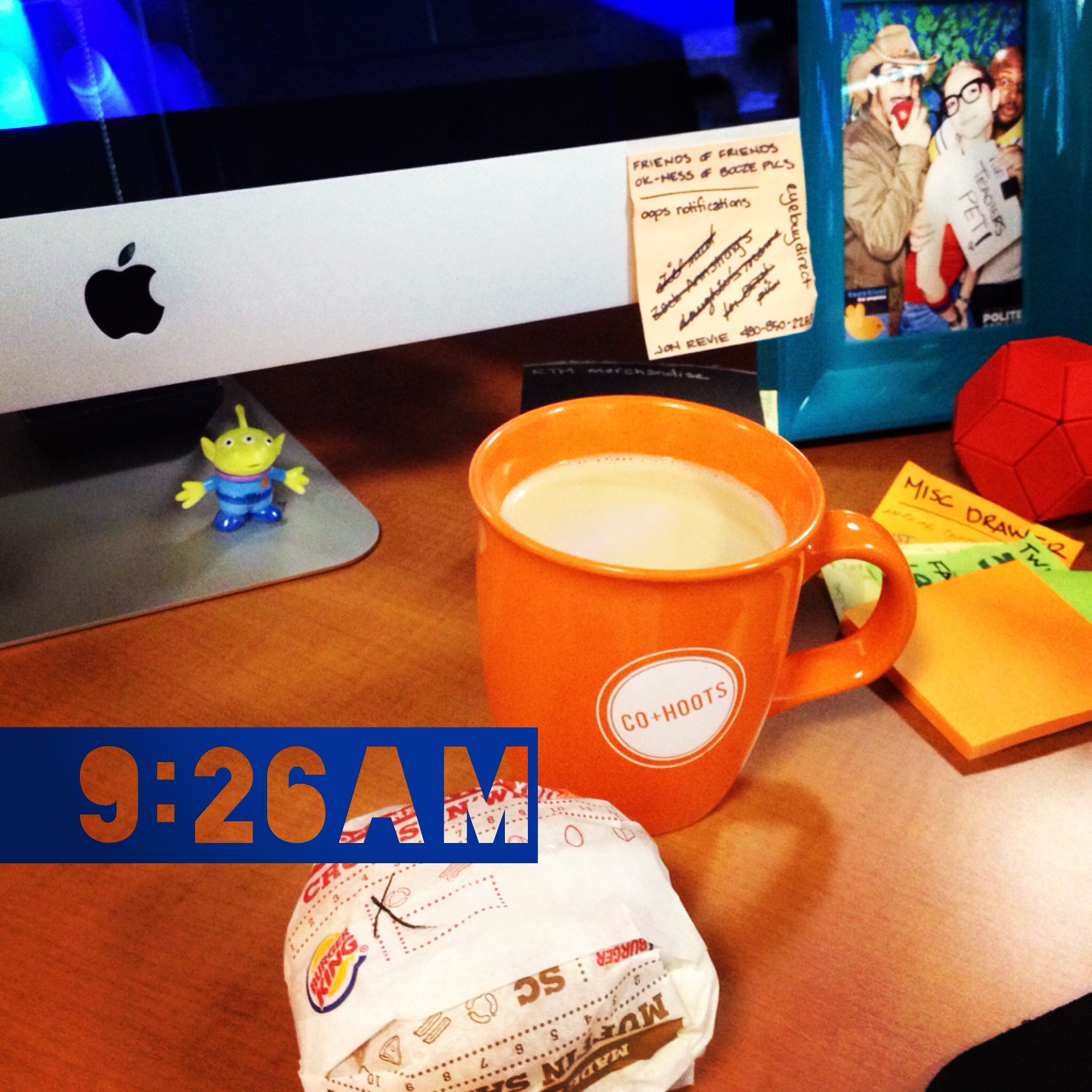
Even though I’m late to work, nothing can progress until I have my coffee. The BK croissan’wich is also a fairly regular fixture on weekday mornings.
9:40am » work
1:34pm » a girl’s gotta eat, lunch edition

Most days at work, I’m far too busy to post updates that aren’t as @RightThisMinute, and today is no different. Let it suffice to say that I am just now headed to lunch.
I barely have time to dash to The Original Burrito Company nearby and pick up a shrimp burrito that I’ll be trying to eat quietly while on a 2pm conference call. This is not unusual for me. I’m incredibly busy. Hour-long lunches are a luxury that I rarely feel like I have time for, so I try to keep lunch short. When I do break free earlier than 1:30pm or take a full hour (sometimes plus), it’s typically because I’m going to lunch with a group of coworkers.
2:05pm » work
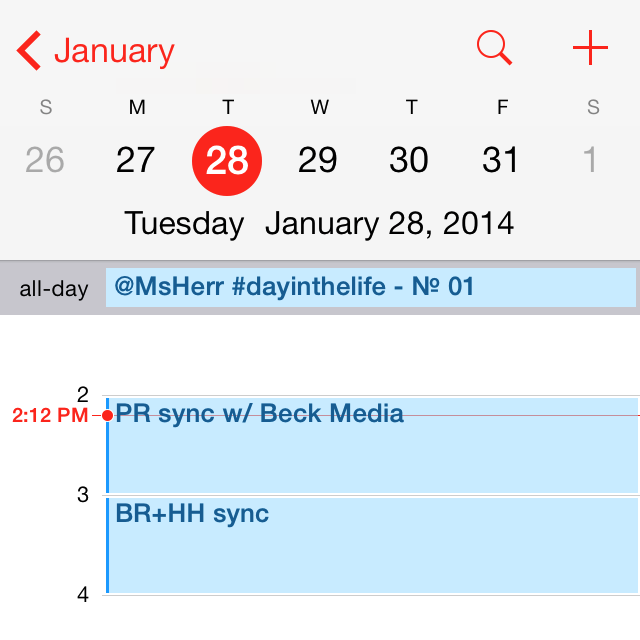
The afternoon meeting lineup…
4:54pm » gaming, Marvel World of Heroes
I need a break. My game energy, attack power, and RDS are are full again, having been replenished throughout the day. I’m not a pay-to-play gamer, so it’s taken me a long time to build a decently strong battle deck. This is the first time I have a real shot at earning some of the more valuable rewards that the spendier players earn with ease.
5:04pm » work
5:54pm » commuting
When I’m lucky enough to leave work before the winter sun sets, I like to steal glances of the colors changing in the sky through my rear- and side-view mirrors on the commute home. This was all that remained of the light as I pulled into my drive.

6:30pm » #dayinthelife documentation
6:56pm » gaming, Marvel World of Heroes
7:15pm » putzing around
The time tracking that I’m doing today is not just a today thing. I have tracked my time in this manner for nearly two and a half years. As such, I’ve become comfortable focusing my attention on one activity for a block of time. The better to categorize, you see. There are times, however, that are hard to categorize. Procrastination, indecisiveness, fatigue, lethargy, or hyperactivity can cause mental or physical ‘rambling’.
I’m doing a bit of both now as I try to decide the what, where, when, and how of my evening, and then develop the initiative to make it happen.
7:36pm » wardrobe change
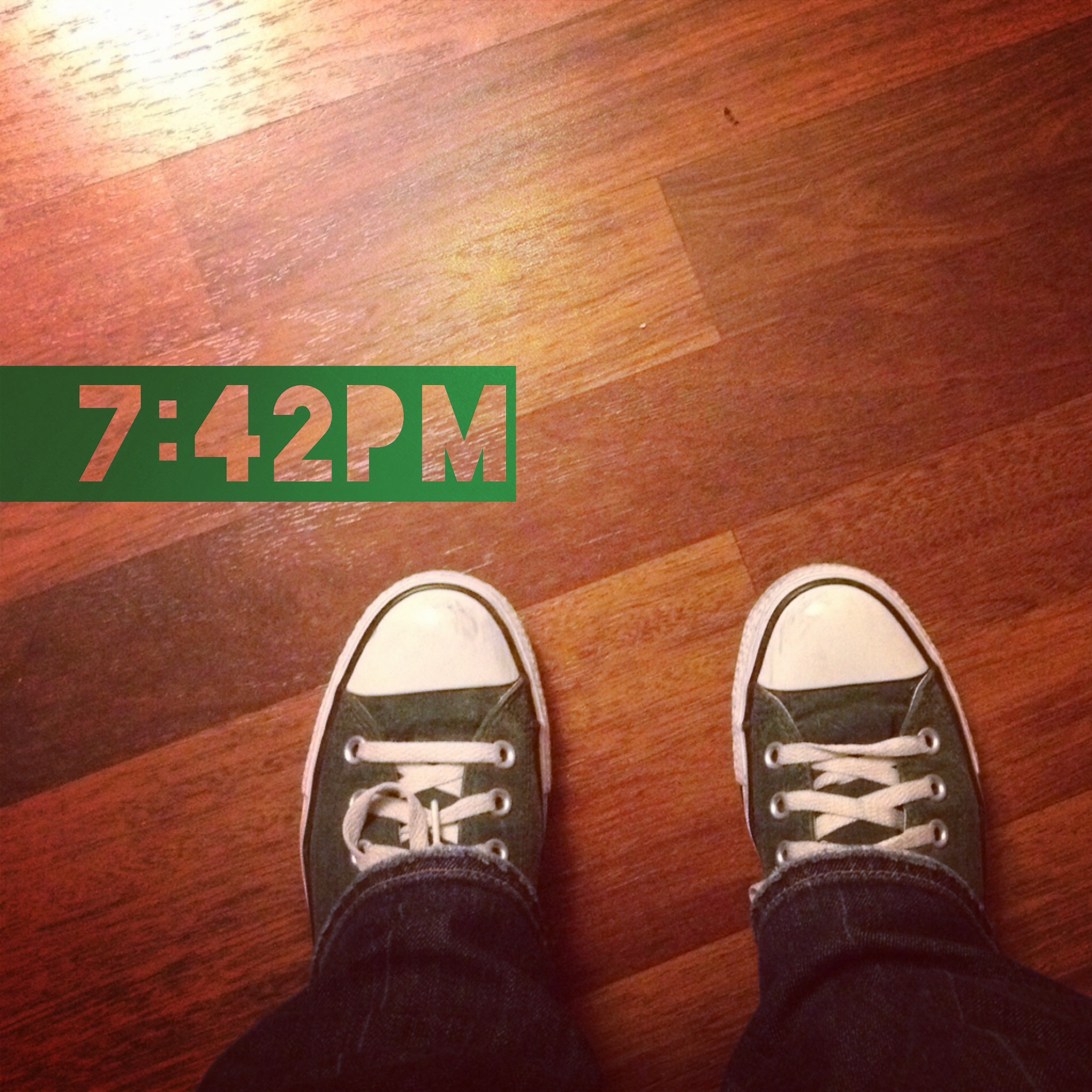
After some failed #selfie attempts (requested by @mspore & @iamchanelle after I posted the jewelry pic), I’ve swapped the sassy black heels for something a little more comfortable for the walk to a nearby restaurant. The round trip should push me over the 10,000 step mark on my #Fitbit.
7:57 pm » walking
8:23pm » a girl’s gotta eat, dinner edition
I don’t cook. I won’t bother with the whys – at least not tonight. My list of reasons excuses isn’t worth your time to read or my time to type. I just don’t cook. But a girl’s gotta eat, and so I eat out a lot. My most common haunt is the Pita Jungle just over a mile from my house. They know me there. Not by name, but by face, by book under arm, and by request for a table for one. Sometimes, they don’t bother providing me with a menu. And they needn’t. I order the same thing every time.

The wood-fired salmon on a bed of wilted spinach and garlic mashed potatoes, paired with red sangria and a book. Harry Potter and the Deathly Hallows. I’m almost done rereading the series.
9:58pm » walking
10:25pm » so fresh so clean sequence, evening edition
10:32pm » gaming, Marvel World of Heroes
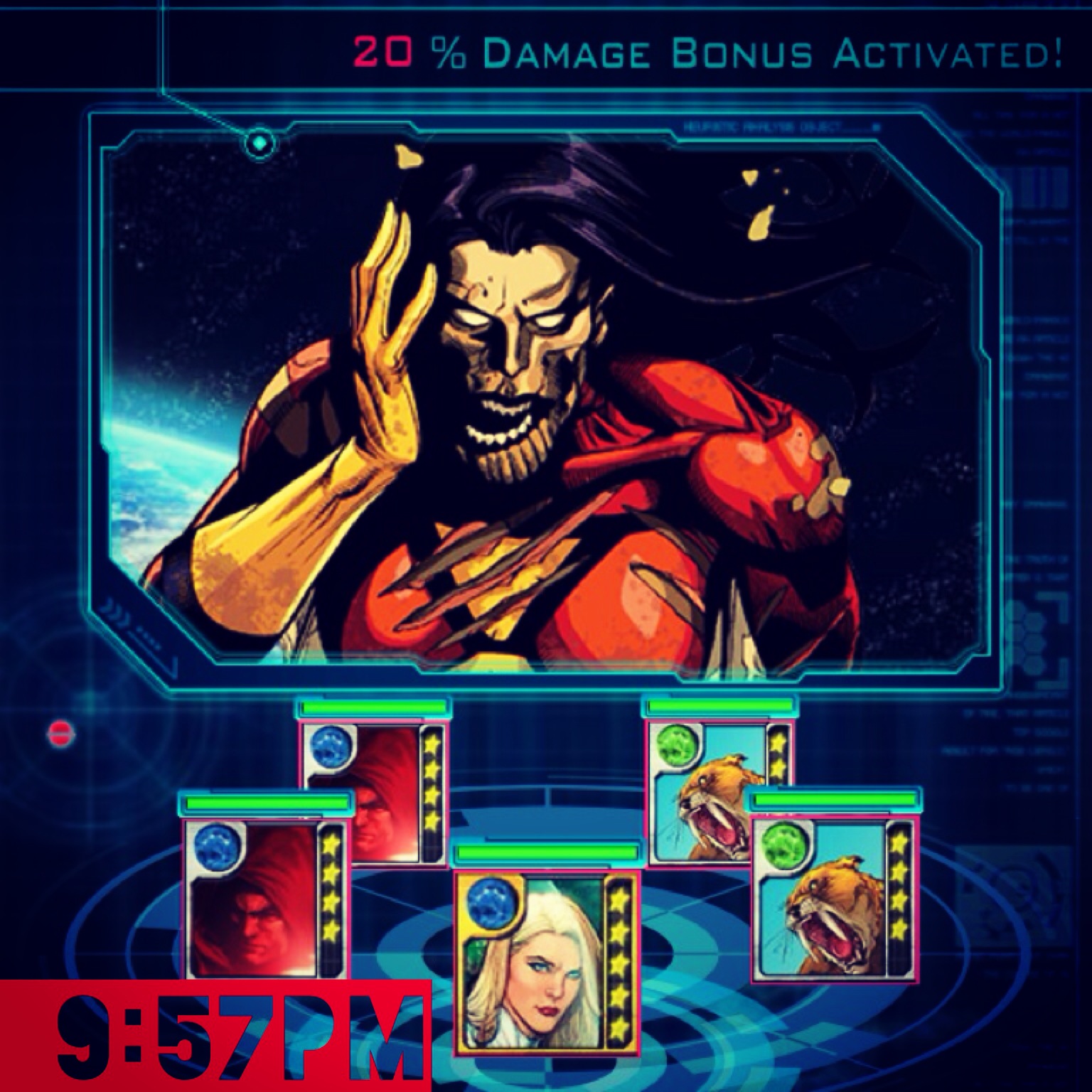
This is my final battle of the raid. I won’t play much until the next event, which will probably start at week’s end.
10:44pm » #dayinthelife documentation
10:52pm » curfew

As I lay me down to sleep… I confess, I sleep with a stuffed animal. Clifford is about half as long as I am tall, and I love him.
11:22pm » sweet dreams
Congratulations
Your first AWS Elastic Beanstalk Node.js application is now running on your own dedicated environment in the AWS Cloud
This environment is launched with Elastic Beanstalk Node.js Platform
What’s Next?
- AWS Elastic Beanstalk overview
- AWS Elastic Beanstalk concepts
- Deploy an Express Application to AWS Elastic Beanstalk
- Deploy an Express Application with Amazon ElastiCache to AWS Elastic Beanstalk
- Deploy a Geddy Application with Amazon ElastiCache to AWS Elastic Beanstalk
- Customizing and Configuring a Node.js Container
- Working with Logs
Day In The Life: Personal Storytelling in 2014
Posted by Ms. Herr in human dimensionality, life, self-portraiture on December 31, 2013
Another year has come to an end, which means people all over the place are summarizing the year. Media companies are recapping the big stories, friends and family are sending annual letters, and social media apps are generating personalized highlight reels.
When I think back on my 2013 (without the help of third-party generators), my first blush impression is of a year that sort of washed together in a “same shit, different day” kind of way. Give me time for reflection, and I can identify stories and memories that highlighted the year. The trip to Havasupai with 2 friends and 160 strangers. A spontaneous July road trip to LA. Time spent with my parents in southwestern Colorado. Learning to ride a motorcycle. Dying my hair blue.

Flatiron, May 2013
There were 365 days in this year. I feel like there should be more. Getting back into hiking. Saturday morning breakfasts in the company of a good book. Facing my fear of water. A school-girl crush so encompassing that I had to embrace my inner crazy.
These were great moments. I don’t want to underplay them. But that “same shit, different day” feeling lingers. Part of me certainly feels guilty for letting life pass me by, for succumbing to a gray monotonous lethargy that has shadowed me much of the past three years. But another part of me questions whether I failed to grasp the beauty and the intrigue that pervades my inclinations, my routines, my everyday life.
I want 2014 to feel different. I want to reverse the sentiment so that even if each different day does promise more of the same shit, it’s really good shit.
I am fascinated with “Day in the Life” exposés because they set aside the big standout events to better highlight the routines and the in-between moments – in other words, the good shit – that when strung together can weave a rich tale of how a larger entity comes to be.
So I am giving myself a project for 2014, to document a day in my own life. Not just once, but once each month. The goal is to tell the unique story of each day and to highlight the routines of necessity and enjoyment that I return to everyday. I also hope to evolve my storytelling skills, so that I am better equipped to tell the tale of a day next December than one next month.
The days of documentation (selected mostly at random): 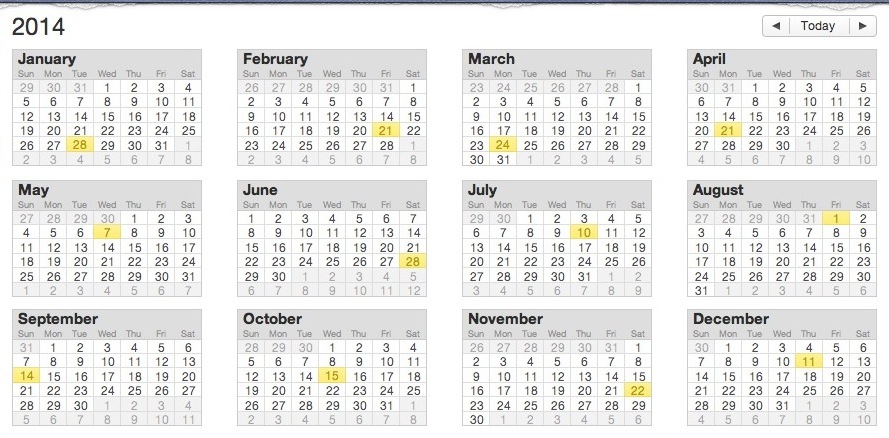
On these days, I am going to try to throw the doors and windows into my life wide open. I will try to share honestly both what I am doing, what I am thinking, and what I am feeling, even if I feel those things are uninteresting or unbecoming.
And now some guidelines, constraints, and caveats (because creativity emerges from the challenge of creating with constraints and because I don’t want to half-ass the project).
- I will attempt to share what I am doing or thinking at least once an hour, even if it means setting little alarms to remind myself.
- Documentation will occur via social media channels. I’m thinking Instagram will be my primary platform, but Twitter, Facebook, and other platforms will undoubtedly come into play.
- Posts will be tagged #dayinthelife.
- I will produce a wrap-up of each day, aggregating all content produced that day into a single summary here.
- I will do my best to honor the privacy and social sharing preferences of any person or party that I may be in the presence of on these days.
- My thoughts regarding project are still evolving, so it’s possible that these guidelines and constraints will change.
What questions or suggestions do you have as I embark on this project?
Congratulations
Your first AWS Elastic Beanstalk Node.js application is now running on your own dedicated environment in the AWS Cloud
This environment is launched with Elastic Beanstalk Node.js Platform
What’s Next?
- AWS Elastic Beanstalk overview
- AWS Elastic Beanstalk concepts
- Deploy an Express Application to AWS Elastic Beanstalk
- Deploy an Express Application with Amazon ElastiCache to AWS Elastic Beanstalk
- Deploy a Geddy Application with Amazon ElastiCache to AWS Elastic Beanstalk
- Customizing and Configuring a Node.js Container
- Working with Logs
on being beautiful
Posted by Ms. Herr in human dimensionality, life, self-portraiture on April 14, 2013
It’s not that I don’t like being told I’m beautiful, but I am unnerved when the compliment comes too frequently. In too short a space of time. Particularly, from a single source.
There aren’t really guidelines for how frequently is too frequently. It’s just a feeling. And I’ve felt more unnerved more frequently.
I’ve been asking myself why. I am grateful to be beholden as beautiful by others – it is no trivial compliment – but why does hearing that they do unsettle me?

#selfportrait January 4, 2013
It’s not that I don’t believe that I am beautiful. In fact, during my ponderances, I discovered that I do see myself as beautiful. Not pretty or cute or attractive. I. Am. Beautiful.
“Do you know how beautiful you are?”
I recently dated a man who asked me this. I’d heard the question before, but this man asked me almost every time we saw each other. And we saw each other at least two or three times a week.
“Do you know how beautiful you are?”
Each time, “Thank you.” And in time, when the intensity of his gaze made it evident that it wasn’t a rhetorical question, that “thank you” was not a satisfactory answer, and that he really wanted to know if I really knew, “There are a lot of beautiful women in the world.”
That wasn’t really a satisfactory answer, either. And so I keep coming back to why. Why does being told I am beautiful too frequently – however frequently that is – unnerve me?
Like for many things, there is likely many reasons. But there is also this one…
Our physical appearance is the first thing that people see – in the most literal meaning of the word – when they see us. Yet it physical beauty is among the least unique of qualities that any one person can possess.
Congratulations
Your first AWS Elastic Beanstalk Node.js application is now running on your own dedicated environment in the AWS Cloud
This environment is launched with Elastic Beanstalk Node.js Platform
What’s Next?
- AWS Elastic Beanstalk overview
- AWS Elastic Beanstalk concepts
- Deploy an Express Application to AWS Elastic Beanstalk
- Deploy an Express Application with Amazon ElastiCache to AWS Elastic Beanstalk
- Deploy a Geddy Application with Amazon ElastiCache to AWS Elastic Beanstalk
- Customizing and Configuring a Node.js Container
- Working with Logs
Facebook Page Engagement Numbers and Quick Competitor Comparisons
Posted by Ms. Herr in social media, social networks, socialmediatoday, the biz side on September 16, 2011
In addition to Likes and Comments, Facebook is now exposing the number of shares a post receives. This number is displayed for both individual user posts, based on that user’s privacy settings, and on Page posts.

Facebook Shares sequence and news feed posts.
There are definite upsides and downsides to the introduction of shares data in its current form for business and brands, who now have an additional qualitative factor on which to evaluate the engagement success of different posts. InsideFacebook has outlined a number of them. In short…
The upside:
- Alert users to the availability of the Share option and increase its usage.
- Give Page admins visibility into what and how often content is reposted (a metric we’ve previously been blind to).
- Identify who is sharing your content (think potential brand advocates).
- Push publishers to actively pursue shares.
The downside:
- Impact of shares on EdgeRank is TBD.
- Share metrics are not (or at least not yet) included in Facebook Insights.
- The repost no longer includes the name of or link back to the source (a major downside for brands).
I think initial excitement over the new shares data point overlooks the fact that some of your most important engagement numbers are right there in the open for all to see. And exposing new data points make your success, or failure, at inspiring your community to action is increasingly public.
Impressions, feedback rates, active users, demographics and daily page likes are all masked behind Insights, visible only to Page admins. The wall is good. Social media performance metrics should enjoy many of the same privacy protections that other business performance metrics do. But consider what is behind the wall, what is in front, and how this affects fan behavior and business intelligence. The exposure of Likes and Comments stands as social proof of how interesting your content is, but it also offers competitors, and the merely curious, a glimpse into how good you are at engaging your community. Now your shares are public too.
Why does this matter? After all competitors can’t see your actual engagement rates, right?
Outsiders may not be able to see your actual impressions or feedback rates, but it’s actually very easy to make an assessment as to how you are performing from an engagement standpoint. I often complete weekly competitor reviews for clients, and I can take a rough measure by comparing interactions to Page Likes. There are services that will do some of this automagically, but the following ‘by hand’ method works well for spot checks.
Add up the total number of Likes and Comments on the last 3 to 5 posts for each Page you’re reviewing (including your own). Divide that by the number of posts you looked at to get the average number of interactions per post, and then divide by the total number of Page Likes. Make sure to use the same sample size for each Page you’re looking at (e.g. last three posts for all Pages).
Interaction Rate = Average (Likes + Comments of last 3 posts) / Total Page Likes
Let’s look at Sons of Anarchy, for example:

Sons of Anarchy post, showing new Shares metric
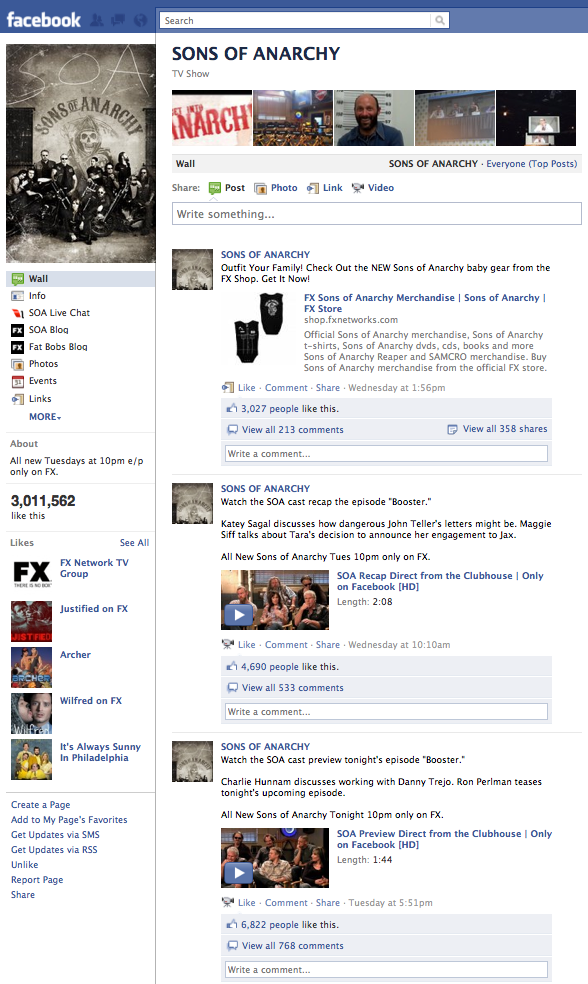
Sons of Anarchy Facebook Page (click to expand)
Post 1 – 3027 Likes, 213 Comments and 358 Shares = 3598 interactions
Post 2 – 4690 Likes, 533 Comments = 5223 interactions
Post 3 – 6822 Likes, 768 Comments = 7590
Total Page Likes – 3,011,562
(Click image at right to view post data and fan count.)
Interaction Rate = ((3598 + 5223 + 7590) ÷ 3) / 3,011,562
Interaction Rate = 0.18%
Jay Baer made a great point awhile back that on Facebook, your competitive set extends beyond other companies in your industry, but all brands and businesses using Pages. You can apply the calculation above to see how any of these brands are performing.
Shares gives you, and me, and additional data point in determining how your social content is performing.
Skilled Facebook Page admins already know that some posts are better suited for generating Likes, and others comments. Ideally, your content mix includes a number of each to keep the fan experience dynamic and engaging. The introduction of shares to the visible metrics lineup will lead to new post types and strategies.
Social media pros, and your competitors, will be stalking your Page to see what works and what doesn’t.
Congratulations
Your first AWS Elastic Beanstalk Node.js application is now running on your own dedicated environment in the AWS Cloud
This environment is launched with Elastic Beanstalk Node.js Platform
What’s Next?
- AWS Elastic Beanstalk overview
- AWS Elastic Beanstalk concepts
- Deploy an Express Application to AWS Elastic Beanstalk
- Deploy an Express Application with Amazon ElastiCache to AWS Elastic Beanstalk
- Deploy a Geddy Application with Amazon ElastiCache to AWS Elastic Beanstalk
- Customizing and Configuring a Node.js Container
- Working with Logs
6 Ingredients for the Secret Sauce: Social Media Best Practices for Big Brands
Posted by Ms. Herr in social media, the biz side on May 13, 2011
This is an expanded version of a guest post that originally appeared on the commpro.biz Thought Leaders blog.
Sushi rolls #socialmediametaphor (image credit: trickypink on Flickr)
Three years ago, few people would have considered Facebook and YouTube the place to be for big brands wanting to connect with customers. With the decline in traditional media consumption and the explosive growth of social media, any company not already participating in direct conversations with fans and followers are scrambling to get up to speed. Whether you’re dipping your toe into the waters, or revisiting your current approach to social, here are six points to guide your efforts.
Lead with strategy
Your fans and followers want to know the benefit of subscribing to your updates. Whether you’re driving sales, extending customer service or reinforcing the brand lifestyle, social media activities should reinforce your business objectives. Establish your goals up front. Develop content to support your goals. Identify performance indicators that you can use to track what’s working and what isn’t.
Who is doing it well? – American Red Cross exists to provide aid to disaster victimes. Social media has the power to spread messages far and fast, and the Red Cross leverages video, photo, status updates and other social communications to mobilize the public to get involved and inform people about how donations and voluteers are making a difference.
Provide employees with social media guidelines and training
Managing social media for a big brand is dramatically different than maintaing a personal account. Not only are the objectives different, but the functionality within a single social site can differ significantly. Facebook is the most obvious example of this, as Pages and profiles each possess unique attributes. Make sure the team on the front lines has the knowledge they need to manage your brand presence. Then, ensure the rest of your employees possess a basic knowledge of how social media works, what your company policy is and how it affects personal and professional usage.
Who is doing it well? – Kodak is well known for their proactive engagement in social media. Early adopters, they remain passionate about social media done right and publicly share their social media tips and policy (PDF).
Listen, listen, and listen some more
Social media pros will tell you that step number one is listening. The intelligence you gain during a pre-implemention phase will guide your strategy, but the listening doesn’t stop once you’ve launched Facebook, YouTube and a blog. The makeup of your community will change as you grow. The platforms you are using will change. The engagement dynmaics will evolve, presenting new challenges and new opportunities. Listen carefully to what is being said. Separate the feedback gold from the noise. Adjust accordingly, and keep listening.
Let your community have a voice
Social media is social. A YouTube account or blog that has commenting disabled becomes just another one-way marketing broadcast channel. ExactTarget’s Subscribers, Fans and Followers: The Social Break-Up report showed that receiving too many marketing messages is a leading reason people stop following a brand’s social media updates. Leave commenting on, ask your subscribers for their input and respond when they share an opinion. Each comment is a latent touch point, allowing you to build stronger relationships with existing and potential customers.
Who is doing it well? – Starbucks launched My Starbucks Idea, a community site where customers can share, discuss and vote on ideas they’d like to see Starbucks adopt. When Starbucks acts on one of these ideas, the community is the first to know.
Have a plan for responding to negative word of mouth
Every company experiences negative word of mouth, some more than others. This is not a time to run and hide. Show your customers that you are listening. Address the issue at hand and work toward a resolution. Whenever possible, respond publicly and on the site where the complaint first occurred. If online dialogue becomes unproductive or personal information is required, take it offline.
Learn from the successes and failures of others
There are several brands doing social media well. Ford Motor Company, Southwest Airlines (Facebook/Twitter), and Red Bull* have each taken a unique approach to social media, but they’re leaders in their industry and in social media. On the other side of aisle, several brands have experienced failures. Some recover, some don’t. Either way, there are valuable lessons you can apply to your own business.
Success in social media requires a clear focus on your goals and a genuine interest in engaging with customers. Plan, implement, experiment, listen and respond. Whether it’s a greater share of market or improved brand health, you’ll find social media can move help you move the needle on your business objectives.
*Red Bull is a Terralever client.
News Sites Sleep While San Francisco Riots
Posted by Ms. Herr in social media, the biz side on November 4, 2010
Originally posted to on the Terralever blog November 2, 2010:
Last night around 8 pm, I settled in for Monday Night Football and a nap. I haven’t gotten a lot of sleep lately – work hard, play hard, live hard is common for Terraleverians. I awoke 3 hours later to ESPN SportsCenter and a great segment on the new World Champion San Francisco Giants. This year’s Giants were a scrappy team of misfits that wanted it more than anyone else. As I hopped online to knock off a couple to do items before calling it a night, I stumbled across the #SFriot tag on Twitter. Giants fans’ celebrations had turned dangerous, complete with crowds, bonfires, vandalism and physical violence. Coverage was all over Twitter, as were links to listen in on SFPD scanners in real-time. As I tuned in, all thoughts of sleep went out the window.
Twitter hashtags are great for real-time updates on a trending topic, but painfully limited when you want the background story. Search engines, on the other hand, are great for this. Google search results for “san francisco riots” returned Mashable’s story on the riots in coveted top slot. Mashable’s story was posted within a couple of hours of the first reports, and painted a quick picture of transpiring events by leveraging citizen journalism – documented accounts of news events reported by members of the public.
It would be easy to cite this as yet another example of the power of social media to break and share news quicker than traditional outlets, just as it was during the Hudson River plane crash and the Haiti earthquake. But that’s a rickety bandwagon. Real-time channels can quickly become muddled by virtual onlookers contributing their own commentary on current events. It happened with #SFriot, where jokes about hipsters and social commentary on, of all things, social media culture.
What is compelling about this particular incident is that social and technology news sites, such as Mashable, TechCrunch, and Gawker dominated the results for two of Google search verticals: aggregated web search and news search. Within the aggregated vertical, after the first three results, Google returned results for other riots. Did traditional news outlets not consider last night’s riots significant enough to cover in a timely fashion? Were they all asleep? Or maybe Google just wasn’t sure my interest was current or historical. Changing the search paramaters to San Francisco (instead of local) had no effect on the quantity or ordering of results.

What does it say when Mashable and TechCrunch rank highest for current events and news search? These sites aren’t focused on general public awareness or safety. They are focused on cultural relevance, but from a very niche viewpoint – social media technologies. Mashable’s post was sufficiently grave, but it was written to showcase the real-time nature of social media and citizen journalism.
As a business or individual, your ‘news’ may not be of the scale or nature of last night’s riots, but right about now, you should be thinking how this changes your outreach and coverage strategies when you have a story to tell.
- Is your ‘news’ really news? Determine whether the information you have affects society at large, a local municipality or just your own customer base.
- What sites and sources are most likely to consider your information newsworthy? Is it editorial content for journalists or conversation points for niche-interest sites?
- What, exactly, is the angle that each of your targeted sites is going for? How do you fit?
- Are you presenting your content in a way that aligns with the goals and audiences of your targeted sites?
- Are you in it for the coverage? Or are you interested in building a relationship with the editors and audiences of each outlet?
Answer those questions, and you’ll know whether traditional media will sleep on your news too and if your strategy should focus on social news and citizen media.
Congratulations
Your first AWS Elastic Beanstalk Node.js application is now running on your own dedicated environment in the AWS Cloud
This environment is launched with Elastic Beanstalk Node.js Platform
What’s Next?
- AWS Elastic Beanstalk overview
- AWS Elastic Beanstalk concepts
- Deploy an Express Application to AWS Elastic Beanstalk
- Deploy an Express Application with Amazon ElastiCache to AWS Elastic Beanstalk
- Deploy a Geddy Application with Amazon ElastiCache to AWS Elastic Beanstalk
- Customizing and Configuring a Node.js Container
- Working with Logs
Goodbye 12seconds.tv! The Death and Life of Early Adoption in Social Media
Posted by Ms. Herr in marketing & advertising, social media on October 25, 2010
Originally posted to on the Terralever blog October 22, 2010:
 Tonight This past Friday, at 8:15pm Pacific Standard Time, the micro-video blogging site 12seconds.tv closes it’s doors forever. Current members are advised to export their videos quickly, or lose them forever. The badges, comments, favorites, bumps, and views stats are not included in the export – they will be lost. As for the people, connections and new friends found in the process of posting, viewing and sharing 12 second videos – hopefully you’ve connected on other platforms, or they too will be lost.
12seconds.tv was a micro-video blogging site where 12ers shared and engaged with one another around short video clips that were 12 seconds long, exactly. 12seconds used gamification tactics, such as badging and daily challenges to encourage frequent use. They developed a variety of additional features to attract businesses, including 12omercials.
Why didn’t 12seconds.tv catch on? From a user perspective, 12 seconds was simply too short of a time, even for micro-video. Read a 140-character tweet aloud, and it will take you roughly 12 seconds. In spite of the benefits of such brevity, it’s challenging to execute in one take. On Twitter, you can edit text in the field. In video, running long requires you to rerecord, a process that can become frustrating, particularly for the novice or the slightly verbose.
Businesses who avoided the platform probably cited such reasons as it being too soon to know if 12seconds would catch on, too few users, and poor video quality. You could make a valid case for each of these, but too often, such reasons are a symptom of bigger issues – an unfamiliarity with social media, an unwillingness to understand it and aversion to experimentation. There are benefits and risks associated with engaging customers and users in open communication.

A handful of brands were bold enough to experiment with 12seconds, among them:
- M&Ms Racing – Leveraging NASCAR and Kyle Busch fans, the M&Ms Racing 12 Seconds Cup featured a series of mini-competitions, wherein participants responded to each challenge with a 12seconds video.
- Mountain Dew – As part of their larger DEWmocracy campaign, which allowed DEW drinkers to drive the development of three new flavors, Mountain Dew invited fans to create the advertising spots for the new DEWs.
- Adidas – In partnership with the Chelsea Football Club, Adidas sponsored the Chelsea’s 12th Man contest, offering U.S. fans the chance to win a spot on the team, albeit on the bench, during a U.S appearance.
The benefits of getting involved early
It would be easy to construe the news of 12seconds.tv closing as evidence of the risks of investing in a social media channel too early, but I’d advise against that. There are significant advantages to being an early adopter on emerging platforms.
- Gain first mover attention – In a space that is constantly evolving, there’s plenty of room to creatively implement new ideas. If you’re the first one to test something, or you’re the first to try it in a way that is remarkably different than predecessors, you’ll grab the attenion of leading digital media outlets and influencers. If you wait too long to get involved, or if your ideas aren’t unique, you become the copy cat, and there’s nothing pressworthy about that.
- Become the benchmark – Back when Twitter was still pretty niche, Frank Eliason started listening for and responding directly to complaints about Comcast. As @comcastcares, delivered execptional customer service. It wasn’t a flashy campaign. Frank was being helpful. Two years later, it’s still one of the best known and most cited examples for how to do social media listening and response the right way.
- Master the learning curve – Each new platform comes with certain learnings. How are users behaving and engaging with the platform? What are the features? Is there a specific nomenclature and culture that pervades the community? How can businesses get involved? The answers to each of these questions differ considerably by each platform, but if you’re connected and engaged, you’ll start to recognize similarities. Learning to recognize engagement patterns, and feature-based exceptions, are key to leveraging any social media channel.
- Establish yourself as a thought leader – The early adopters of any product or technology often become the people who teach everyone who follows. Experiementing with an emerging social media platform, and sharing that knowledge with others will significantly, and positivitly impact your influence, garnering attention for you and the brand you represent.
Remember, it’s not about you, it’s about your customers. If the people you seek to connect with are playing in a particular social media channel, you should probably give some serious thought to rolling up your pant legs and getting your feet wet.
*If you’d like to leave a comment, please feel free to do so here and/or on the original post on the Terralever blog.
Congratulations
Your first AWS Elastic Beanstalk Node.js application is now running on your own dedicated environment in the AWS Cloud
This environment is launched with Elastic Beanstalk Node.js Platform
What’s Next?
- AWS Elastic Beanstalk overview
- AWS Elastic Beanstalk concepts
- Deploy an Express Application to AWS Elastic Beanstalk
- Deploy an Express Application with Amazon ElastiCache to AWS Elastic Beanstalk
- Deploy a Geddy Application with Amazon ElastiCache to AWS Elastic Beanstalk
- Customizing and Configuring a Node.js Container
- Working with Logs
PodCamp AZ 2010 badge hackery
Posted by Ms. Herr in events, geekery, Phoenix, Phoenix events on September 21, 2010
This morning, I received an email from the WordCamp Phoenix 2011 regarding registration (I’m already registered) and badging up. Being the geek conference groupie that I am, I had to badge up. I added the “Meet me at” section you see over there in the sidebar, but the WordCamp badge was all by itself and looked lonely. I decided I needed to add badges for other events I’m attending, but of the ones I’m currently reg’d for (PodCamp AZ 2010 and Startup Weekend Phoenix), neither has badges. The @podcampaz avatar, however, has the event dates on it, so I thought I’d see if I could make my own.
Before you go thinking to yourself, “Oh, that’s easy!” remember that I am not a code monkey. I’m a groupie. Big difference.
Anyway, long story short … OK, short story short, I made a badge with working link and everything. If you like it, and want one for yourself, you’re welcome to this one (code below), at least until PodCamp organizers publish their own.

<a href=”http://podcampaz.com” title=”PodCamp AZ 2010″><img src=”http://msherrwhenonline.com/wp-content/uploads/Twitter_podcampaz_2010_small.png” alt=”PodCamp AZ 2010″ title=”PodCamp AZ 2010″ style=”border:none;” /></a>
I’m super excited with this little bit of ingenious hacking. No doubt I’m overstating things. Regarding the ingenuity. And the hacking. But I’m not overstating the excited part. Really, it’s the little things. 🙂
Congratulations
Your first AWS Elastic Beanstalk Node.js application is now running on your own dedicated environment in the AWS Cloud
This environment is launched with Elastic Beanstalk Node.js Platform
What’s Next?
- AWS Elastic Beanstalk overview
- AWS Elastic Beanstalk concepts
- Deploy an Express Application to AWS Elastic Beanstalk
- Deploy an Express Application with Amazon ElastiCache to AWS Elastic Beanstalk
- Deploy a Geddy Application with Amazon ElastiCache to AWS Elastic Beanstalk
- Customizing and Configuring a Node.js Container
- Working with Logs